SCIENCE & TECHNOLOGY

How Data Pays: The Hidden Cost Of Convenience
SCIENCE & TECHNOLOGY

How Data Pays: The Hidden Cost Of Convenience

The hidden cost of convenience: How your data pulls in hundreds of billions of dollars for app and social media companies You wake up in the morning and, first thing, you open your weather app. You close that pesky ad that opens first and check the forecast. You like your weather app, which shows hourly weather forecasts for your location. And the app is free! But do you know why it’s free? Look at the app’s privacy settings. You help keep it free by allowing it to collect your information, including: What devices you use and their IP and Media Access Control addresses. Information you provide when signing up, such as your name, email address and home address. App settings, such as whether you choose Celsius or Fahrenheit. Your interactions with the app, includi...
Science & Technology Today: Innovations Shaping Our Future
SCIENCE & TECHNOLOGY

Science & Technology Today: Innovations Shaping Our Future

SCIENCE & TECHNOLOGY TODAY: Innovations Shaping Our Future In 2025, science and technology continue to evolve at an unprecedented pace, transforming how we live, work, and interact with the world. From artificial intelligence to space exploration, today's innovations are solving complex problems and opening up new frontiers. Here’s a look at some of the most significant developments making headlines in science and technology today. 1. AI and the Rise of Hyper-Intelligent Systems Artificial Intelligence (AI) has entered a new phase with the emergence of "agentic AI"—systems that can reason, plan, and act autonomously in real-world environments. These AI agents are now assisting in scientific research, automating logistics, enhancing cybersecurity, and even co-authoring academic pap...
Be Aware Of What Data AI Tools Collect And Store About You
AI, SCIENCE & TECHNOLOGY

Be Aware Of What Data AI Tools Collect And Store About You

AI tools collect and store data about you from all your devices – here’s how to be aware of what you’re revealing   Like it or not, artificial intelligence has become part of daily life. Many devices – including electric razors and toothbrushes – have become “AI-powered,” using machine learning algorithms to track how a person uses the device, how the device is working in real time, and provide feedback. From asking questions to an AI assistant like ChatGPT or Microsoft Copilot to monitoring a daily fitness routine with a smartwatch, many people use an AI system or tool every day. While AI tools and technologies can make life easier, they also raise important questions about data privacy. These systems often collect large amounts of data, sometimes without people even realizing...
How AI Is Reshaping Student Writing
AI, SCIENCE & TECHNOLOGY

How AI Is Reshaping Student Writing

AI isn’t replacing student writing – but it is reshaping it I’m a writing professor who sees artificial intelligence as more of an opportunity for students, rather than a threat. That sets me apart from some of my colleagues, who fear that AI is accelerating a glut of superficial content, impeding critical thinking and hindering creative expression. They worry that students are simply using it out of sheer laziness or, worse, to cheat. Perhaps that’s why so many students are afraid to admit that they use ChatGPT. In The New Yorker magazine, historian D. Graham Burnett recounts asking his undergraduate and graduate students at Princeton whether they’d ever used ChatGPT. No one raised their hand. “It’s not that they’re dishonest,” he writes. “It’s that they’re paralyzed.” Students se...
New Ways Scientists Can Help Put Science Back Into Popular Culture
SCIENCE & TECHNOLOGY

New Ways Scientists Can Help Put Science Back Into Popular Culture

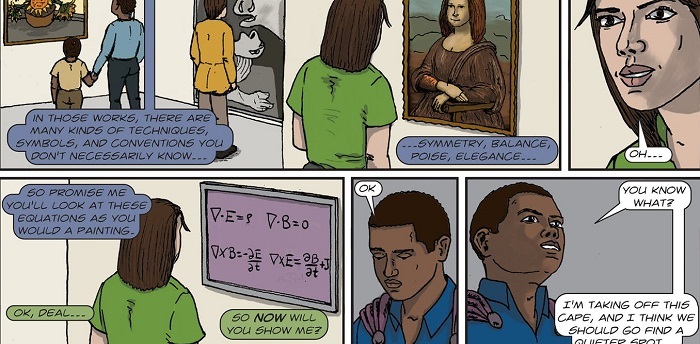
How often do you, outside the requirements of an assignment, ponder things like the workings of a distant star, the innards of your phone camera, or the number and layout of petals on a flower? Maybe a little bit, maybe never. Too often, people regard science as sitting outside the general culture: A specialized, difficult topic carried out by somewhat strange people with arcane talents. It’s somehow not for them. But really science is part of the wonderful tapestry of human culture, intertwined with things like art, music, theater, film and even religion. These elements of our culture help us understand and celebrate our place in the universe, navigate it and be in dialogue with it and each other. Everyone should be able to engage freely in whichever parts of the general culture they c...
The End Of Revenge And Deepfake Porn
SCIENCE & TECHNOLOGY, VIDEO REELS

The End Of Revenge And Deepfake Porn

How the Take It Down Act tackles nonconsensual deepfake porn − and how it falls short. President Donald Trump signed the Take It Down Act into law on May 19, 2025. The U.S. House of Representatives passed the bill by a vote of 409-2 on April 28, 2025, after the U.S. Senate passed it by unanimous consent on Feb. 13, 2025. The law is an effort to confront one of the internet’s most appalling abuses: the viral spread of nonconsensual sexual imagery. The Take It Down Act targets “non-consensual intimate visual depictions” – a legal term that encompasses what most people call revenge porn and deepfake porn. These are sexual images or videos, often digitally manipulated or entirely fabricated, circulated online without the depicted person’s consent. The law offers victims a mechanism to for...
Predictive Policing AI — A Real Life Reality
SCIENCE & TECHNOLOGY, VIDEO REELS

Predictive Policing AI — A Real Life Reality

Predictive policing AI is on the rise − making it accountable to the public could curb its harmful effects. The 2002 sci-fi thriller “Minority Report” depicted a dystopian future where a specialized police unit was tasked with arresting people for crimes they had not yet committed. Directed by Steven Spielberg and based on a short story by Philip K. Dick, the drama revolved around “PreCrime” − a system informed by a trio of psychics, or “precogs,” who anticipated future homicides, allowing police officers to intervene and prevent would-be assailants from claiming their targets’ lives. The film probes at hefty ethical questions: How can someone be guilty of a crime they haven’t yet committed? And what happens when the system gets it wrong? While there is no such thing as an all-seeing ...
What Color Do You See?
SCIENCE & TECHNOLOGY

What Color Do You See?

Colors are objective, according to two philosophers − even though the blue you see doesn’t match what I see. Is your green my green? Probably not. What appears as pure green to me will likely look a bit yellowish or blueish to you. This is because visual systems vary from person to person. Moreover, an object’s color may appear differently against different backgrounds or under different lighting. These facts might naturally lead you to think that colors are subjective. That, unlike features such as length and temperature, colors are not objective features. Either nothing has a true color, or colors are relative to observers and their viewing conditions. But perceptual variation has misled you. We are philosophers who study colors, objectivity and science, and we argue in our book “Th...
Teaching AI Machines
SCIENCE & TECHNOLOGY, VIDEO REELS

Teaching AI Machines

What is reinforcement learning? An AI researcher explains a key method of teaching machines – and how it relates to training your dog. Understanding intelligence and creating intelligent machines are grand scientific challenges of our times. The ability to learn from experience is a cornerstone of intelligence for machines and living beings alike. In a remarkably prescient 1948 report, Alan Turing – the father of modern computer science – proposed the construction of machines that display intelligent behavior. He also discussed the “education” of such machines “by means of rewards and punishments.” Turing’s ideas ultimately led to the development of reinforcement learning, a branch of artificial intelligence. Reinforcement learning designs intelligent agents by training them to maximi...
Science Research Funding Cuts — Cuts American Lives Short
SCIENCE & TECHNOLOGY, VIDEO REELS

Science Research Funding Cuts — Cuts American Lives Short

Cuts to science research funding cut American lives short − federal support is essential for medical breakthroughs. Nearly every modern medical treatment can be traced to research funded by the National Institutes of Health: from over-the-counter and prescription medications that treat high cholesterol and pain to protection from infectious diseases such as polio and smallpox. The remarkable successes of the decades-old partnership between biomedical research institutions and the federal government are so intertwined with daily life that it’s easy to take them for granted. However, the scientific work driving these medical advances and breakthroughs is in jeopardy. Federal agencies such as the National Institutes of Health and the National Science Foundation are terminating hundreds o...