
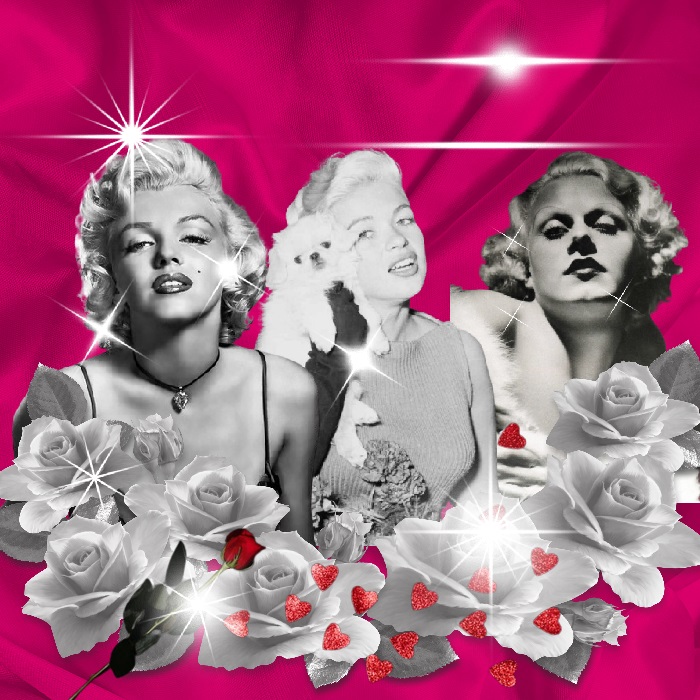
Blonde stereotypes are stereotypes of blonde-haired people. Sub-types of this stereotype include the “blonde bombshell” and the “dumb blonde”. Blondes have historically been portrayed as physically attractive, though often perceived as less intelligent compared to their brunette counterparts. There are many blonde jokes made on these premises. However, research has shown that blonde women are not less intelligent than women with other hair colors.
The blonde bombshell is one of the most notable and consistently popular female character types in cinema. Many Hollywood celebrities have used it to their advantage, including Jean Harlow, Marlene Dietrich, Marilyn Monroe, Jayne Mansfield, Brigitte Bardot and Mamie Van Doren.
There are several aspects to the stereotypical perception of blonde-haired women.
In contemporary popular culture, it is often stereotyped that men find blonde women more physically attractive than women with other hair colors. For example, Anita Loos popularized this idea in her 1925 novel Gentlemen Prefer Blondes. Blondes are often assumed to have more fun; for example, in a Clairol commercial for hair colorant, they use the phrase “Is it true blondes have more fun?” Some women have reported they feel other people expect them to be more fun-loving after having lightened their hair. In much of the Americas, the blonde stereotype is associated with being less serious or less intelligent. However, an analysis of IQ data carried out by the National Longitudinal Surveys on a survey database of American “baby boomers” (NLSY79 data), the natural blonde women in this population category (excluding African American and Hispanic persons) have a slightly higher mean IQ than brunettes, black and red-haired women.
On the other hand, a blonde woman is often perceived as making little use of intelligence and as a “woman who relies on her looks rather than on intelligence.” At the same time, people tend to presume that blondes are less serious-minded and less intelligent than brunettes, as reflected in “blonde jokes”. The root of this notion may be traced to Europe, with the “dumb blonde” in question being a French courtesan named Rosalie Duthé, satirised in a 1775 play Les Curiosités de la Foire for her habit of pausing a long time before speaking, appearing not only stupid but literally dumb (meaning mute). The latter stereotype of “dumb blonde” is exploited in blonde jokes. In Brazil, this extends to blonde women being disparaged, as reflected in sexist jokes, as sexually licentious.
Alfred Hitchcock preferred to cast blonde women for major roles in his films as he believed that the audience would suspect them the least, comparing them to “virgin snow that shows up the bloody footprints”, hence the term “Hitchcock blonde”. This stereotype became so ingrained that it spawned counter-narratives, such as in the 2001 film Legally Blonde, in which Reese Witherspoon succeeds at Harvard Law School despite biases against her beauty and blonde hair, and terms such as cookie-cutter blonde (CCB), implying standardized blonde looks and standard perceived social and intelligence characteristics of a blonde. Many actors and actresses in Latin America and Hispanic United States have blonde hair and blue eyes and/or pale skin, such as Christina Aguilera and Shakira.
Blonde bombshell
The blonde bombshell is a gender stereotype that connotes a very physically attractive woman with blonde hair. A review of English language tabloids from the United Kingdom has shown it to be a recurring blonde stereotype, along with “busty blonde” and “blonde babe”.
Jean Harlow started the stereotype with her film Bombshell of 1933. Following her, Marilyn Monroe, Jayne Mansfield and Mamie Van Doren helped establish the stereotype typified by a combination of curvaceous physique, very light-colored hair and a perceived lack of intelligence. During the 1950s, the blonde bombshell started to replace the Femme fatale as the mainstream media stereotype. Marjorie Rosen, a historian of women in films, says of the two top blonde bombshells of the time that “Mae West, firing off vocal salvos with imperious self-assurance, and Jean Harlow, merchandising her physical allure for the masses, transformed the idea of passive female sexuality into an aggressive statement of fact”.
Dumb blonde
The notion of “dumb blonde” has been a topic of academic research reported in scholarly articles and university symposia, which tend to confirm that many people hold to the perception that light-haired women are less intelligent than women with dark hair. It is believed the first recorded “dumb blonde” was an 18th-century blonde French courtesan named Rosalie Duthé whose reputation of being beautiful and dumb, even in the literal sense of not talking much, inspired a play about her called Les Curiosités de la Foire (Paris 1775).
While there is no evidence that suggests that blondes are less intelligent than other people, it has been suggested earlier that the state of being blonde probably creates opportunities that do not require investing in education and training. A possible earlier hypothetical explanation is that physically attractive women have less pressing incentives to cultivate and demonstrate their intellect to ensure their future, since physical attractiveness is an asset, or correlatively that intelligent women have less pressing incentives to dye their hair to a presumed attractive color. The purported validity of this explanation is purely hypothetical and has been corroborated earlier by its applicability to a similar pervasiveness of the “dumb athlete” stereotype. At the same time, newer data have shown that natural blondes have the highest IQ among white women, which is already explained by the scientists as possible greater incentive to intellectual activity in the place where the blonde grew up, which directly refutes the earlier suggestion that blondes have less intellectual incentives. The dumb blonde stereotype (and the associated cognitive bias) may have some negative consequences and it can also damage a blonde person’s career prospects.
Gentlemen Prefer Blondes (1925) by Anita Loos originated as a comic novel and explores the appeal of blonde women. It spawned a musical on Broadway, and two films released in 1928 and 1953. The Encyclopedia of Hair describes Marilyn Monroe’s blonde role in the second film as that of “a fragile woman who relied on her looks rather than on intelligence—what some people refer to as ‘dumb blonde’.” At the same time, in the film she demonstrates a certain amount of wit regarding her life position expressed in the song “Diamonds Are a Girl’s Best Friend“. Madonna emulated that screen-persona of Monroe in her music video Material Girl.
Many blonde actresses have played stereotypical “dumb blondes”, including Monroe (dyed blonde), Judy Holliday, Jayne Mansfield (dyed blonde), Carol Wayne and Goldie Hawn. Goldie Hawn is best known as the giggling “dumb blonde”, stumbling over her lines, especially when she introduced Rowan & Martin’s Laugh-In “News of the Future”. In the American sitcom Three’s Company the blonde girl (originally Chrissy, played by Suzanne Somers, and later Cindy and Terri) is sweet and naïve, while the brunette (Janet, played by Joyce DeWitt) is smart.
Country music star Dolly Parton who recorded a song called “Dumb Blonde”, famously said that dumb blonde jokes about her do not offend her because, “I know I am not dumb, and I am not blonde.
Every product is selected by editors. Things you buy through our links may earn The IRL News a commission.